The Government e-Marketplace (GeM) offers Indian sellers massive revenue opportunities through direct public procurement. Navigating high-demand segments and completing your GeM registration online is key to securing frequent government orders.
This comprehensive guide highlights the best-selling categories on GeM in 2026, from IT hardware to green products, helping every GeM seller maximize bidding success and commercial growth.
What Is GeM Registration And Why Does It Matter?
Government e-Marketplace (GeM) is the primary digital procurement portal established by the Government of India to streamline public sector purchasing. Completing your gem registration online gives your business direct visibility to over 70,000 government buyer organizations, including Central and State Ministries, Public Sector Undertakings (PSUs), defense establishments, and municipal bodies. Under Rule 149 of the General Financial Rules (GFR), public entities are legally mandated to fulfill their supply requirements through this platform, turning registration into an essential gateway to multi-crore government procurement budgets.
To register as an active gem seller, your business must onboard under one of two primary account profiles:
- Original Equipment Manufacturer (OEM): Designed for businesses that manufacture products, hold brand trademarks, or create proprietary services. OEMs have exclusive rights to create primary product catalogs, set specifications, and authorize downstream sellers.
- Reseller: Designed for authorized distributors, dealers, or stockists selling verified existing catalog items with valid OEM authorizations.
Eligibility is extended to all legal business entities operating in India, including sole proprietorships, partnerships, LLPs, private limited companies, and MSMEs. To onboard successfully and start bidding on high-value contracts for Government e-Marketplace products, sellers must provide the following essential credentials:
- PAN Card: Personal PAN for proprietorships or Company PAN for corporate entities.
- Active GSTIN: Mandatory for listing taxable goods and receiving direct government payments.
- Aadhaar Card: Linked to a mobile number for identity verification and e-signing contracts.
- Bank Details: Active current account details and IFSC code for direct payment settlements.
- Udyam / DPIIT Certificate (Optional): Unlocks statutory MSME benefits, including Earnest Money Deposit (EMD) exemptions and purchase preferences.
Failing to register on GeM effectively excludes vendors from participating in state and central government tenders. To complete your portal account correctly, explore our step-by-step GeM Seller Registration guide|Complete Profile Setup & Document Checklist Guide.
Understanding GeM's Expanding Marketplace
The Government e-Marketplace (GeM) has transformed public procurement in India from a slow, paper-heavy process into an agile digital ecosystem. GeM's Gross Merchandise Value (GMV) has crossed ₹4 Lakh Crore annually, driven by mandatory procurement policies enforced across Central Ministries, State Departments, Defense establishments, and Public Sector Undertakings (PSUs). For Indian business owners, this massive capital flow represents an unparalleled opportunity to tap into high-volume government purchase orders.
This massive expansion is fueled by strategic policy mandates that directly favor domestic manufacturers and underrepresented business groups:
- Make in India (MII) Dominance: Under the Public Procurement (Preference to Make in India) Order, buyers on the platform prioritize suppliers who meet local content thresholds (Class-I local suppliers with ≥50% local content). This policy makes domestic manufacturing a primary credential for securing best-selling categories on GeM in 2026.
- Mandatory MSME Quotas: Central Ministries and CPSEs are legally obligated to procure at least 25% of their total annual purchases from Micro and Small Enterprises (MSEs). Registered MSMEs enjoy crucial advantages, including Earnest Money Deposit (EMD) exemptions, purchase preferences, and tender fee waivers.
- Inclusive Growth via 'Womaniya' and SC/ST Mandates: Specific sub-targets reserve 3% of overall procurement for women-led enterprises and 4% for SC/ST entrepreneurs, providing niche business owners a direct channel to supply Government e-Marketplace products without heavy corporate competition.
Whether you are an established original equipment manufacturer (OEM) or an emerging reseller aiming for GeM trending products 2026, positioning your business in these GeM top categories requires strict compliance and complete onboarding. Eligible enterprise owners should complete their Government e Marketplace (GeM) Registration 2026 | Step-by-Step Seller & Buyer Guide India and verify their vendor credentials on the official GeM portal to leverage these federal purchase mandates.
Top Trending Product Categories On Gem In 2026
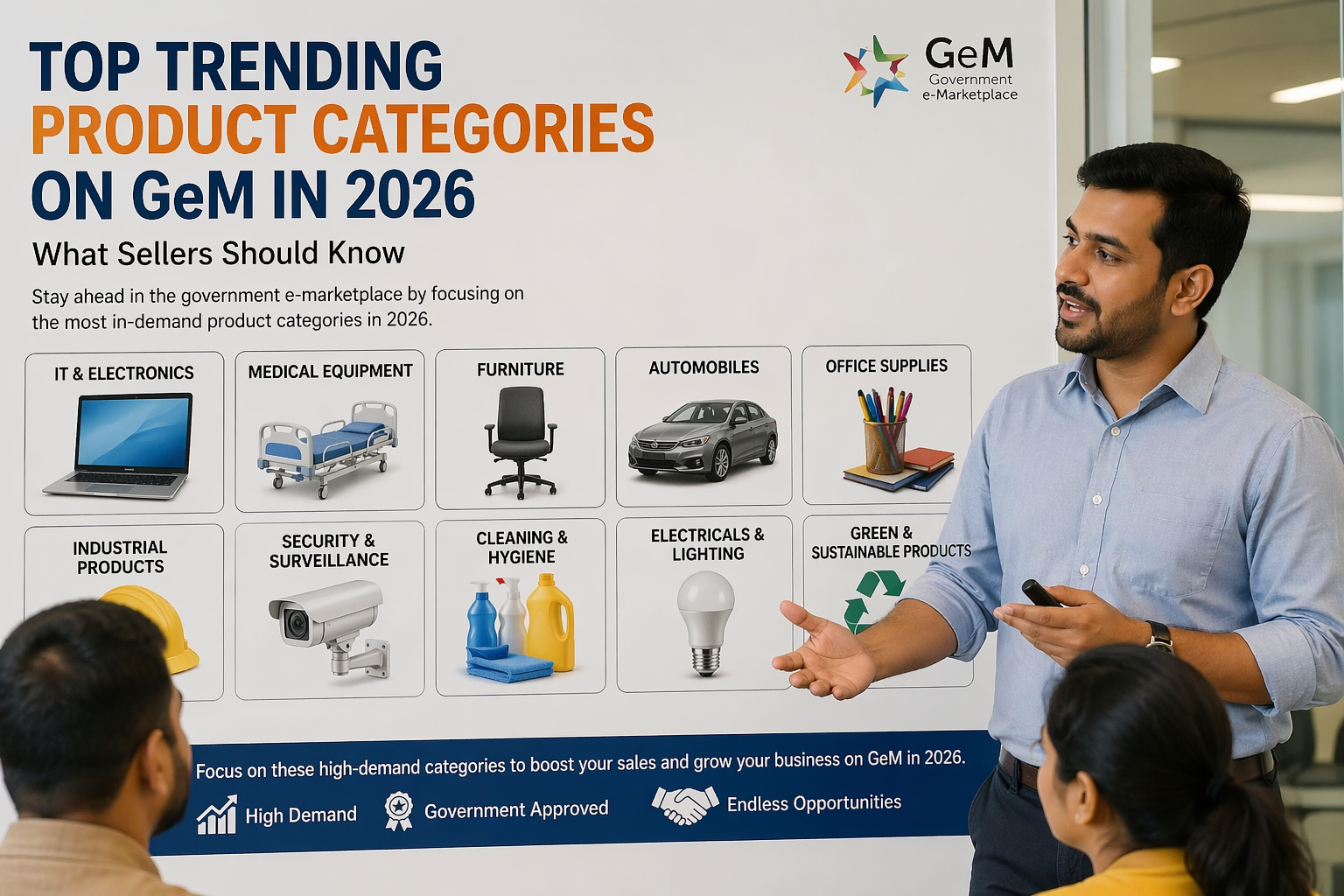
Public procurement in India has witnessed explosive growth, driven by mandatory purchasing guidelines under General Financial Rules (GFR). To maximize purchase order conversion, MSMEs and enterprise vendors must align their catalog with high-turnover sectors. According to official transaction trends on GeM, the following sectors represent the best-selling categories on GeM in 2026:
1. IT Hardware and Digital Infrastructure
With digitisation mandates across state and central departments, demand for compute infrastructure remains at an all-time high. Best-selling items include desktops, heavy-duty laptops, rack servers, and AI-enabled CCTV surveillance cameras utilized in Smart City tenders. Hardware must strictly conform to BIS safety standards and STQC certifications where applicable.
2. Electric Vehicles (EV) & Charging Infrastructure
Accelerated by green transit initiatives like PM-eBus Sewa, state transport undertakings and municipal bodies are actively bidding for commercial EVs, lithium-ion battery packs, and EV charging stations. Automotive suppliers providing OEM-compliant components see massive volume orders.
3. Healthcare & Hospital Equipment
Public health upgrades under national wellness initiatives have created immense demand for ICU ventilators, multi-para patient monitors, digital X-ray units, and rapid diagnostic kits. Equipment compliance requires CDSCO approvals and valid ISO certifications before approval on the portal.
4. Solar Energy & Green Products
As government departments aim to reduce carbon footprints, rooftop solar panels, solar water pumps, and energy-efficient LED lighting systems are experiencing peak buyer traffic. Certified green products receive preferential consideration during evaluation.
5. Modular Office Furniture & Infrastructure
From central secretariats to district-level collectorates, ergonomic mesh chairs, modular workstations, and heavy-duty steel almirahs remain consistent high-frequency purchases. Compliance with BIFMA and ISO standards speeds up catalog approvals.
6. Facility Management & Manpower Services
Service procurement is expanding rapidly alongside physical products. High-demand services include facility maintenance, outsourced security guards, sanitation management, and vehicle hiring solutions for administrative staff.
To capture these high-value opportunities, vendors must structure their catalog with exact OEM part numbers and compliance certificates. Learn how to map your inventory accurately with our How to List Your Products on GeM for Maximum Visibility & Sales | Complete GeM Product Listing Guide.
How to Track High-Demand Tenders Using GeM Portal Analytics
To capitalize on GeM trending products 2026, registered vendors must move beyond standard catalog uploads and actively monitor platform intelligence. The portal provides built-in tools that allow every gem seller to analyze buying patterns, active bids, and pricing history before stocking inventory or submitting proposals.
1. Filter Active Bids by Category and Volume
Navigate to the public tender section on the official GeM portal to inspect active procurements. Utilize advanced filters to narrow down bids by Ministry, State, estimated contract value, and delivery timeline. Sorting active tenders by high-quantity custom requirements helps identify emerging government needs early, showing you which Government e-Marketplace products are seeing sudden spikes in demand.
2. Analyze Historical Contract Data and L1 Rates
Tracking historical purchase data is essential for evaluating margin feasibility. By accessing archived bid results, sellers can analyze past L1 (Lowest 1) winning prices, contract quantities, and preferred brand specifications. This data reveals the best-selling categories on GeM in 2026 and prevents underquoting or overpricing. For a complete walkthrough on analyzing tender notices and managing active bids, check out our comprehensive guide on GeM Bid, GeM Registration Online & GeM Tender List.
3. Set Up Automated Keyword and Category Alerts
Configure your seller dashboard preferences to receive real-time email notifications for specific UNSPSC categories and primary keywords. Tracking high-frequency tenders across key sectors like IT infrastructure, solar energy, and healthcare equipment allows MSMEs to prepare mandatory documentation—such as OEM authorization letters and BIS test reports—well before tender closing dates.
Important Seller Guidelines To Succeed On GeM In 2026
Succeeding on the Government e-Marketplace (GeM) requires more than simply uploading inventory; it demands continuous operational compliance, strategic pricing, and strict adherence to portal policies. As procurement norms tighten in 2026, sellers must optimize every operational metric to capture high-value government orders.
1. Maintain Dynamic, Direct-Purchase Pricing
Government buyers frequently utilize Direct Purchase (up to ₹25,000) and L1 Buying (from ₹25,000 to ₹5,00,000) standard mechanisms. GeM strictly enforces the "Most Favoured Customer" clause, requiring sellers to guarantee that quoted rates on the portal are lower than or equal to prices on any other e-commerce or commercial channel. Audit your catalog regularly to keep prices competitive against automated L1 comparison algorithms on the GeM portal.
2. Clear Vendor Assessment for OEM Status
To list products as an Original Equipment Manufacturer (OEM) without product caps or category restrictions, vendors must complete the mandatory Vendor Assessment conducted by the Quality Council of India (QCI). While exemptions exist for micro and small enterprises with valid Udyam certificates in specific primary categories, non-exempt vendors must ensure their manufacturing facility details, quality control processes, and ISO certifications are verified to get immediate approval.
3. Secure Valid OEM Authorization Codes
Resellers cannot upload or list branded catalog items without an official OEM Authorization Code generated directly from the primary brand owner's GeM dashboard. Build strong trade channels with primary OEMs so authorization requests are validated promptly, preventing missed bidding windows during large tenders.
4. Protect Your Seller Rating and Incident Profile
GeM uses an automated Vendor Rating algorithm heavily weighted by buyer feedback, delivery timeliness, and dispute logs. Maintain a score above 4.5 stars by adopting these core practices:
- Strict Delivery Schedules: Fulfill orders within the agreed Delivery Period (DP). Apply for DP extensions prior to expiration if supply chain delays arise.
- Rapid Incident Resolution: Respond to buyer deviations or complaints within 48 hours to avoid penalty points under the GeM Incident Management Policy.
- Real-Time Stock Management: Update inventory stock in real time to avoid auto-cancellation penalties caused by stockouts.
For detailed tactics on catalog structuring, dynamic pricing rules, and search optimization, explore our practical walkthrough on How to List Your Products on GeM for Maximum Visibility & Sales.
Mandatory Quality Certifications for Top GeM Categories
To successfully list and sell high-volume items on the Government e-Marketplace, compliance with rigorous quality standards is non-negotiable. Government procurement officers on the portal screen vendors based on strict safety, environmental, and operational compliance. Uploading authentic, active certifications during catalog creation is essential to ensure your products rank among the best-selling categories on GeM in 2026 without facing catalog rejection.
Key Compliance Standards for Primary Catalog Listings
- BIS Certification (Bureau of Indian Standards): Mandatory for consumer electronics, IT hardware (laptops, servers, desktops), solar modules, and electrical appliances. Items falling under the Compulsory Registration Scheme (CRS) require a valid R-Number or ISI mark issued to the Original Equipment Manufacturer (OEM).
- ISO Standards (ISO 9001, ISO 14001, ISO 13485): ISO 9001 (Quality Management System) is standard for generic categories like office furniture, stationery, and facility services. ISO 13485 is mandatory for medical devices and hospital equipment listings.
- CE Marking & NABL Test Reports: Independent laboratory test reports from NABL-accredited labs (issued within the specified parameter timeframe, usually 1 to 3 years) are compulsory for heavy machinery, safety gear, and lab equipment. CE certification is mandatory for medical equipment and technical items.
- Make in India (MII) Self-Declaration: In line with DPIIT directives, every gem seller must declare local content percentage. Class-I Local Suppliers (≥50% local content) receive primary purchase preference in tenders over Class-II (20%–40%) and non-local suppliers.
Submitting invalid test reports or expired ISO certificates can lead to immediate catalog rejection or seller account suspension on the platform. To ensure your catalog passes administrative checks seamlessly, consult our detailed How to List Your Products on GeM for Maximum Visibility & Sales | Complete GeM Product Listing Guide. You can also review updated parameters directly on the official GeM portal prior to publishing your inventory.
Common Seller Mistakes & How To Avoid Them
Capitalizing on GeM trending products 2026 offers high profit margins, but operational errors on the portal can severely harm your business reputation. Government buyers operate under strict procurement guidelines, meaning procedural lapses can lead to financial deductions, rejected consignments, or complete seller account de-panelment. Every verified gem seller must avoid these key pitfalls to maintain high vendor rating metrics.
1. Incorrect Catalog Mapping & Product Categorization
One of the most frequent errors is misclassifying inventory to match popular search queries or selecting incorrect UNSPSC categories. Incorrect catalog mapping leads to immediate rejection during the technical evaluation stage of a tender. To optimize your catalog correctly without violating terms, follow proper listing practices outlined in our guide on How to List Your Products on GeM for Maximum Visibility & Sales | Complete GeM Product Listing Guide.
2. Bidding Without Guaranteed Stock Readiness
Winning bids in the best-selling categories on GeM in 2026 requires reliable supply chain readiness. Participating in high-value bids without confirmed inventory or OEM approval often results in default. On the GeM portal, failure to execute a generated Purchase Order (PO) within the stipulated timeframe triggers auto-cancellation and places your account under incident management.
3. Ignoring SLA Delivery Timelines and Liquidated Damages (LD)
Delays in dispatching Government e-Marketplace products invite severe financial penalties. GeM enforces an automated Liquidated Damages (LD) policy for delayed deliveries:
- LD Financial Deduction: Calculated at 0.5% per week (or part thereof) of delay on the value of delayed supplies.
- Maximum Penalty Cap: The maximum cumulative LD deduction is capped at 10% of the total contract value.
- Incident Escalation: Delays exceeding 30 days beyond the delivery date empower buyers to cancel contracts and initiate seller blacklisting for 6 to 24 months.
4. Overlooking Buyer-Specific ATC Clauses
Sellers often focus solely on the General Terms and Conditions (GTC) while ignoring Buyer Specific Additional Terms & Conditions (ATC). Inspecting required certifications (such as BIS, ISO, or NABL test reports) prior to submitting bids ensures compliance and protects your business from bid disqualification.
Conclusion – Ready To Sell In GeM top categories?
The Public Procurement ecosystem in India is growing at an unprecedented rate, with annual transaction volumes on the portal crossing lakhs of crores. Capitalizing on the best-selling categories on GeM in 2026—ranging from IT hardware and medical equipment to green energy products and administrative services—presents a lucrative revenue stream for micro, small, and medium enterprises (MSMEs) as well as large enterprise suppliers. However, identifying high-demand Government e-Marketplace products is only the first step; closing orders requires swift execution and complete platform compliance.
To successfully transition into a top-performing gem seller, follow this clear roadmap to audit your business setup:
- Complete Profile Setup & Assessment: Verify your Aadhaar-linked mobile number, PAN details, bank account credentials, and vendor assessment. Ensure your seller profile reaches 100% completion by following our detailed GeM Seller Registration guide|Complete Profile Setup & Document Checklist Guide.
- Upload High-Quality, Compliant Catalogs: List your offerings under the correct GeM top categories, paying strict attention to technical parameter mappings, golden parameters, and required certifications (such as BIS, ISO, or CE).
- Track Active Bids and Tenders: Regularly monitor published L1 purchase thresholds, Custom Bids, and BOQ tenders on the official portal at gem.gov.in to capture government orders before competition intensifies.
- Maintain Excellent Vendor Ratings: Deliver orders within agreed timelines and fulfill warranty commitments to protect your seller rating, which heavily impacts vendor eligibility for high-value tenders.
Whether you are launching a new enterprise or expanding an existing business, completing your gem registration online and optimizing your listings for GeM trending products 2026 puts your brand directly in front of thousands of central, state, and PSU buyers nationwide. Take action today, align your catalog with government procurement priorities, and secure your market share in public procurement.
Top Trending Categories on GeM (2026): Key Procurement Sectors, Demand Metrics, and Mandatory Certifications
| GeM Product Category / Sector |
Best-Selling Items (2026) |
Est. Procurement Volume / Share |
Key Buying Authorities |
Mandatory Certifications & Compliance |
| IT Hardware & Office Automation |
Laptops, All-in-One Desktops, Enterprise Servers, Multi-Function Printers |
High (22% Total GMV) |
Central Ministries, Defence, State IT Depts |
BIS Registration, ROHS, Energy Star / BEE Star Rating |
| Medical Equipment & Healthcare |
Patient Monitors, ICU Beds, Oxygen Concentrators, Surgical Consumables |
High (18% Total GMV) |
Public Hospitals, AIIMS, Defence Medical Services |
CDSCO Clearance, ISO 13485, CE / USFDA Approval |
| Automotive & Electric Vehicles (EV) |
Electric Utility Vehicles, Staff Buses, Ambulances, E-Rickshaws |
Medium-High (15% Total GMV) |
Municipal Corporations, Transport Depts, PSUs |
ARAI / ICAT Homologation, FAME II / EMPS Compliance |
| Green Energy & Solar Systems |
Solar PV Modules, Grid-Tied Inverters, Solar Street Lights, Batteries |
Medium-High (14% Total GMV) |
REDA, Railways, Smart City Projects |
ALMM Listing, BIS (IS 14286), MNRE Approved Standards |
| Office Furniture & Infrastructure |
Ergonomic Mesh Chairs, Modular Workstations, Metal Storage Cabinets |
Medium (12% Total GMV) |
Educational Institutes, CPWD, PSU Offices |
BIFMA Certification, ISO 9001 / 14001, OEM Authorization |
| Surveillance & Security Systems |
CCTV Cameras (IP/Dome), Biometric Attendance, Baggage Scanners |
Medium (10% Total GMV) |
Police Depts, Airport Authorities, Smart Cities |
STQC OEM Certificate, ONVIF Profile S, BIS Security Standards |
| Updated: August 2026 |
Frequently Asked Questions
How can I complete GeM seller registration online?
To complete GeM registration online, visit the official Government e-Marketplace portal and select the 'Register as Seller' option. Provide your Aadhaar/PAN details, business information, bank account details, and address proof. Once your profile is verified, complete the OTP authentication to activate your seller account and start listing products or services.
Source: Government e-Marketplace (GeM)
What are the trending and best-selling product categories on GeM in 2026?
The top trending categories on GeM in 2026 include IT hardware (laptops, desktops, servers), medical equipment, office furniture, solar power systems, automobile vehicles, and manpower services. Additionally, green tech items and smart classroom equipment have seen massive demand from various government departments, central ministries, and public sector undertakings nationwide.
Source: Ministry of Commerce and Industry
Is GeM registration online free for MSMEs and small businesses?
Yes, seller registration on the Government e-Marketplace is completely free of charge for all businesses, including MSMEs, startups, and small enterprises. However, sellers may need to pay a nominal caution money deposit depending on their turnover and business type, which is refundable subject to platform terms and compliance rules.
Source: Ministry of MSME
What documents are needed for GeM registration for sellers?
Key documents required for GeM seller registration include a valid PAN card, Aadhaar number linked to a mobile number, GSTIN certificate, active bank account details, and address proof. MSMEs should also provide their Udyam Registration Certificate to claim preferential benefits under Public Procurement Policies for Micro and Small Enterprises.
Source: Government e-Marketplace (GeM)
How can an Original Equipment Manufacturer (OEM) register and authorize resellers on GeM?
An OEM registers on GeM by verifying their brand credentials, trademark registration, or manufacturing license. Once approved, the OEM panel allows manufacturers to create product catalogues and issue vendor authorization codes (quadrant authorization) to trusted resellers, enabling authorised dealers to sell official OEM products directly to government buyers.
Source: Government e-Marketplace (GeM)
What are the penalties if a seller fails to deliver products on time on GeM?
Delayed deliveries on GeM attract Liquidated Damages (LD) charges, usually deducted at a fixed percentage per week of delay up to a prescribed cap. Repeated delivery failures or order cancellations may result in seller account suspension, negative vendor rating, or blacklisting from participating in future government tenders across the portal.
Source: Government e-Marketplace (GeM)