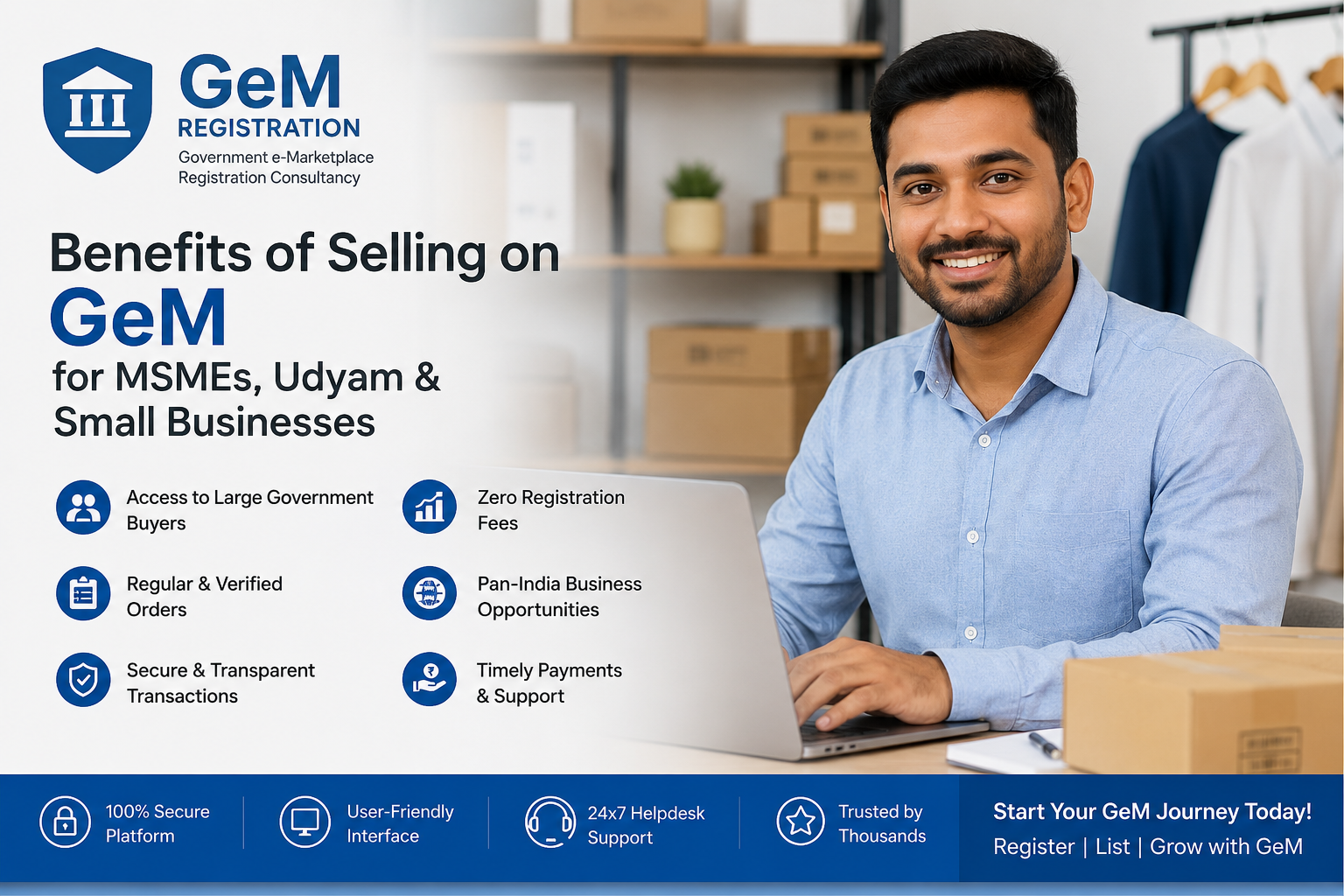
The Government e-Marketplace (GeM) portal offers Indian MSMEs and small businesses direct access to over 70,000 public sector buyers. Selling on GeM eliminates intermediaries, ensures guaranteed payment timelines through PFMS integration, and provides equal bidding opportunities for government contracts.
This comprehensive guide details the key benefits of selling on GeM for MSMEs, essential Udyam documentation, and the step-by-step registration process to grow your business digitally.
What Is the GeM Portal?
The Government e-Marketplace (GeM) is an end-to-end, digital public procurement platform launched by the Ministry of Commerce & Industry, Government of India, in August 2016. Managed under the Directorate General of Supplies and Disposals (DGS&D), GeM serves as a single-window portal designed to facilitate the online purchase of common-use goods and services required by Central and State Government ministries, departments, Public Sector Undertakings (PSUs), defense establishments, and local municipal bodies across India.
Before the establishment of the official GeM portal, government procurement relied heavily on manual tender processes, fragmented vendor networks, and lengthy approval cycles. Under Rule 149 of the General Financial Rules (GFR) 2017, the Ministry of Finance made it mandatory for all central departments and PSUs to procure available goods and services exclusively through GeM. This statutory push transformed Indian public buying into a transparent, competitive, and cashless procurement ecosystem that now processes over ₹4 lakh crore in annual Gross Merchandise Value (GMV).
For small business owners, startup founders, and service providers, the GeM portal operates similarly to an enterprise-grade e-commerce marketplace. Registered sellers can list their product catalogs—ranging from office stationery, medical equipment, and IT hardware to specialized services like cleaning, security, and cloud hosting—and gain direct access to over 70,000 verified government buyer organizations across the country.
Crucially, GeM is deeply integrated with key national databases, including the Udyam portal for MSMEs. Learning How Udyam Registration Helps in Getting Government Tenders on GeM Portal | MSME Benefits Guide allows micro and small enterprises to leverage statutory perks like Earnest Money Deposit (EMD) exemptions, price preference in L1 evaluations, and reserved procurement quotas defined under the Public Procurement Policy for MSEs.
Key Benefits of Selling on GeM
The Government e-Marketplace (GeM) has transformed public procurement in India, providing a transparent, efficient, and inclusive digital ecosystem. For Micro, Small, and Medium Enterprises (MSMEs) and Udyam-registered businesses, registering as a seller on the platform unlocks lucrative growth avenues across federal and state procurement sectors.
1. Direct Access to Thousands of Public Sector Buyers
GeM connects small business owners directly with over 70,000 government buyer organizations, including Central Ministries, State Departments, Defense Establishments, and Public Sector Undertakings (PSUs). Vendors can sell products and services nationwide without setting up expensive regional distribution networks or hiring third-party middlemen.
2. Zero Registration and Listing Fee
Onboarding as a seller on the official GeM portal involves zero initial registration fees or hidden listing charges. This zero-cost entry dramatically lowers market entry barriers for micro-enterprises and women-led startups compared to traditional commercial tender platforms.
3. Transparent Bidding and Reverse Auctions
GeM offers multiple purchasing modes tailored to order size—including Direct Purchase for orders up to ₹25,000, L1 buying, and competitive Reverse Auctions (RA). Sellers benefit from automated, price-competitive bidding processes where rules are clear, minimizing manual intervention and red tape.
4. Guaranteed Timely Payments via PFMS Integration
Working capital constraints often deter small businesses from taking government orders. GeM solves this by integrating with the Public Financial Management System (PFMS). Under the portal's payment guidelines, buyers are mandated to release payments within 10 days of generating the Consignee Receipt and Acceptance Certificate (CRAC). Buyers failing to adhere face automatic interest penalties, protecting seller cash flow.
5. Reserved Quotas and Policy Exemptions for MSMEs
Under the Public Procurement Policy for MSEs, 25% of annual purchases by Central Ministries and PSUs are reserved for MSEs, with specific sub-allocations for SC/ST and women entrepreneurs. Additionally, verified Udyam sellers enjoy exemptions from paying Earnest Money Deposits (EMD). Discover How Udyam Registration Helps in Getting Government Tenders on GeM Portal | MSME Benefits Guide to maximize these reserved exemptions and boost your tender win rate.
GeM Portal Registration Process for MSMEs
Registering as a seller on the Government e-Marketplace is a streamlined, paperless process. MSMEs can complete their onboarding on the official GeM Portal by following this structured step-by-step guide:
Step 1: Primary User Setup & Aadhaar/PAN Verification
Visit the portal and select "Sign Up" as a Seller. The primary user—who must be a proprietor, partner, or authorized director—must initiate verification using their Aadhaar number or Virtual ID (VID). An OTP will be sent to the mobile number linked with Aadhaar. Next, enter the entity’s PAN card details for real-time validation against the Income Tax database.
Step 2: Udyam Registration Validation
To access MSME-specific benefits, enter your 16-digit Udyam Registration Number along with your registered mobile number. The GeM portal automatically syncs with the Ministry of MSME database to fetch your business category (Micro, Small, or Medium), enterprise type, and social category (SC/ST/Woman-owned). You can review How Udyam Registration Helps in Getting Government Tenders on GeM Portal | MSME Benefits Guide to maximize your eligibility for procurement reserves.
Step 3: Business Profile & GSTIN Entry
Complete your profile by entering your registered office address, organization type, and turnover details. Enter your active GSTIN (if applicable) and upload recent IT Returns (ITR) for income verification. Achieving a 100% profile completion score is essential before listing products or services.
Step 4: Bank Account Verification
Provide your official bank account details, including account number and IFSC code. GeM conducts a penny-drop verification to ensure account authenticity. This bank account will be directly linked to the Public Financial Management System (PFMS) for secure, direct online payments from government buyers.
Step 5: Caution Money Deposit
To ensure transaction discipline, sellers must deposit caution money into their dedicated GeM e-wallet. The mandatory deposit amounts are tiered based on annual turnover:
- Turnover less than ₹1 Crore: ₹5,000
- Turnover between ₹1 Crore and ₹10 Crores: ₹10,000
- Turnover above ₹10 Crores: ₹25,000
Once the caution money is credited and profile details are verified, your seller account goes live, allowing you to list products and submit tender bids immediately.
Why GeM Portal Is Ideal for MSMEs
The Government e-Marketplace (GeM) is designed to level the playing field for Micro, Small, and Medium Enterprises (MSMEs) by eliminating structural barriers in public procurement. Under the Public Procurement Policy for Micro and Small Enterprises (MSEs Order, 2012), the portal grants specific statutory benefits that reduce financial liability and ease competitive requirements for registered small vendors on the official GeM portal.
Key Policy Advantages for MSME Sellers
- Exemption from Earnest Money Deposit (EMD): Bidding on traditional public tenders requires vendors to park significant capital as EMD or bid security. On GeM, verified MSE sellers holding a valid Udyam registration are completely exempt from submitting EMD, allowing small businesses to participate in multiple high-value tenders without locking up crucial working capital.
- Relaxation in Prior Turnover and Experience Criteria: Government buyers on GeM are empowered to relax mandatory conditions regarding prior turnover and prior operating experience for MSEs, provided the goods or services meet the required technical and quality specifications.
- Mandatory 25% Procurement Target: Central Ministries, Departments, and Central Public Sector Enterprises (CPSEs) are required to fulfill a mandatory minimum of 25% of their total annual purchases from MSEs. Within this target, 4% is reserved for MSEs owned by SC/ST entrepreneurs and 3% for MSEs owned by women.
- L1 Price Preference (L1 + 15% Band): When an MSE quotes a price falling within the price band of L1 + 15%, they are permitted to bring down their price to match the L1 price of a non-MSE seller, securing a contract portion of up to 25% of the total tender value.
- Reserved Product & Service Categories: The Ministry of MSME has reserved over 358 specific items exclusively for procurement from the micro and small sector, ensuring guaranteed market access.
To unlock these policy exemptions during bidding, sellers must ensure their business details are updated and verified. Discover details on How Udyam Registration Helps in Getting Government Tenders on GeM Portal | MSME Benefits Guide to streamline your profile verification and tender participation.
MSME GeM Registration: What You Need
Before initiating your seller onboarding on the Government e-Marketplace (GeM), ensuring that your credentials and business documents are updated and verified is essential for a seamless profile validation process. For micro, small, and medium enterprises (MSMEs), assembling the correct prerequisites up front ensures immediate access to platform benefits such as Earnest Money Deposit (EMD) exemptions and purchase preferences under the Public Procurement Policy.
Here is the complete mandatory document checklist required to complete your registration on the portal:
- Active Udyam Registration Number (URN): A valid Udyam certificate is mandatory to classify your business as an MSME on the portal. Understanding How Udyam Registration Helps in Getting Government Tenders on GeM Portal | MSME Benefits Guide allows you to effectively leverage turnover waivers and reserved tender categories.
- Permanent Account Number (PAN): An active business PAN card (or personal PAN in the case of a sole proprietorship) that matches the legal entity name verified in the Income Tax Department database.
- Goods and Services Tax Identification Number (GSTIN): A verified, active GSTIN registered under your business name. GeM integrates directly with the GST portal to auto-validate state-wise tax credentials and address details.
- Aadhaar-Linked Mobile Number: The Aadhaar number of the key authorized person, proprietor, or director must be connected to an active mobile number to receive Time-Based Passwords (OTP) for digital signatures and account authentication.
- Active Bank Account Credentials: Bank account details—including Account Number, Account Type, and bank IFSC Code—must align with the registered business entity to enable automated payment dispatches via PFMS (Public Financial Management System).
- Income Tax Return (ITR) Filings: ITR acknowledgment details for the last 1 to 3 financial years (ITR-3, ITR-4, ITR-5, or ITR-6). Valid ITR entries automatically calculate your verified annual turnover rating on the platform.
Having all these verified credentials ready accelerates profile completion to 100%, allowing immediate access to direct orders up to ₹25,000 and L1 bidding. Sellers can complete their profile validation on the official GeM Portal to start bidding on government contracts across India.
GeM Portal Seller Benefits at a Glance
The Government e-Marketplace (GeM) provides a streamlined, transparent, and highly accessible ecosystem designed to empower micro, small, and medium enterprises across India. By standardizing buyer-seller interactions, the platform drastically reduces sales cycles and eliminates traditional entry barriers in public sector procurement.
To maximize your trade opportunities, understanding the key procurement thresholds and automated policy advantages available on the official GeM portal is essential for every small enterprise:
- Direct Purchase Threshold (Up to ₹25,000): Government buyers can purchase products or services directly from any registered vendor on the platform without floating a tender, provided the total order value does not exceed ₹25,000. This allows small suppliers to secure instant purchase orders with minimal documentation.
- L1 Procurement Limit (Up to ₹5 Lakhs): For orders valued between ₹25,000 and ₹5,000,000 (₹5 Lakhs), purchasing officers can finalize procurements through an automated direct price comparison among at least three different sellers, awarding the order immediately to the lowest evaluated (L1) vendor.
- Automated Purchase Preference for MSEs: Under the Central Government Public Procurement Policy, Micro and Small Enterprises enjoy automated procurement preferences. If an MSE seller's bid falls within the L1 + 15% price band during competitive bidding, they are allowed to match the L1 price to split the order and secure at least 25% of the total quantity.
- Exemption from Earnest Money Deposit (EMD): Udyam-verified sellers are completely exempt from paying bid security or EMD fees when participating in government tenders, preserving critical working capital for routine operations.
To fully capitalize on these financial privileges and direct buying thresholds, linking your enterprise credentials during registration is mandatory. Learn more about How Udyam Registration Helps in Getting Government Tenders on GeM Portal | MSME Benefits Guide to ensure your profile qualifies for automated purchase preferences and tender exemptions.
GeM Purchase Preference Policy for Micro and Small Enterprises (MSEs)
One of the strongest commercial advantages of selling on the Government e-Marketplace is the strict enforcement of the Public Procurement Policy for Micro and Small Enterprises (MSEs). Under this government mandate, all Central Ministries, Departments, and Central Public Sector Undertakings (CPSUs) are required to procure a minimum of 25% of their overall annual purchases of goods and services exclusively from verified MSEs. This mandate ensures dedicated market share for small-scale manufacturers and service providers across India.
Breakdown of the 25% Reserved Procurement Quota
The 25% annual procurement reservation is designed to promote social equity alongside economic growth. The target is broken down into specific sub-quotas that government buyers must fulfill on the portal:
- 4% Reserved for SC/ST Entrepreneurs: Dedicated specifically to Micro and Small Enterprises owned by Scheduled Caste (SC) and Scheduled Tribe (ST) business owners.
- 3% Reserved for Women Entrepreneurs: Carved out exclusively for MSEs owned and managed by women business leaders to promote female economic participation.
- 18% for General MSEs: Allocated for all remaining verified Micro and Small Enterprises operating across supply categories.
The L1 + 15% Price Preference Benefit
In competitive tender evaluations, MSEs receive an advantageous price preference mechanism. If a non-MSE vendor emerges as the lowest bidder (L1), any participating MSE whose quoted price falls within the price band of L1 + 15% is invited to match the L1 price. Upon matching the price, the MSE vendor is awarded a contract for at least 25% of the total tendered quantity.
To claim these purchase preferences, tender fee waivers, and Earnest Money Deposit (EMD) exemptions, business owners must link their valid Udyam certificate during profile creation. Learning how Udyam registration helps in getting government tenders on GeM portal helps enterprise owners streamline their compliance and take full advantage of these legal provisions. You can review detailed policy documents directly on the official GeM Portal.
Ready to Sell on GeM? Start Your MSME Journey Today
Transitioning from a traditional business to an active vendor on the Government e-Marketplace (GeM) requires a structured approach. To maximize your order volume and consistently secure high-value public procurement contracts, your enterprise must establish a fully compliant, verified, and proactive presence on the platform.
4 Actionable Steps for GeM Seller Success
- Keep Your Udyam Profile Synced: Ensure your Udyam Registration Certificate details match your GST, PAN, and primary GeM seller account precisely. An active profile unlocks major tender privileges, including complete exemption from Earnest Money Deposit (EMD), relaxed prior experience criteria, and MII (Make in India) purchase preferences. Learn How Udyam Registration Helps in Getting Government Tenders on GeM Portal | MSME Benefits Guide to leverage these exemptions during bid submission.
- Optimize Your Catalog Listing: Upload complete technical specifications, clear product imagery, and precise HSN/SAC codes. Government procurement officers perform direct purchases for orders up to ₹25,000 and L1 comparisons up to ₹5,00,000 based entirely on automated catalog matching filters.
- Secure Brand and OEM Approvals: If you manufacture your own products, register as an Original Equipment Manufacturer (OEM) on the portal. Micro and Small Enterprises (MSEs) enjoy fee waivers for Vendor Assessment under specific criteria. Resellers must request brand authorization from verified OEMs to sell branded inventory and prevent catalog removal.
- Monitor Bids and Tender Notifications Daily: Visit the official GeM portal regularly to search for relevant Custom Bids, Reverse Auctions (RA), and BOQ (Bill of Quantities) tenders matching your UNSPSC product categories. Set up tailored notification alerts so your team never misses critical submission deadlines.
By maintaining accurate product offerings, managing stock availability, and striving for a seller rating above 4.5 stars, small businesses can establish immediate trust with central ministries, state departments, and PSUs across India.
❓ FAQs on Selling on GeM for MSMEs
1. Is seller registration free on GeM, and what transaction fees apply to MSMEs?
Yes, primary registration on the Government e-Marketplace is 100% free. However, to start listing products or services, sellers must deposit a one-time refundable Caution Money based on enterprise type—₹5,000 for Micro & Small Enterprises (MSEs), ₹10,000 for Medium Enterprises, and ₹25,000 for non-MSMEs. GeM charges zero transaction fees for order values up to ₹5 Lakh. For order values exceeding ₹5 Lakh, a nominal transaction fee (ranging from 0.05% to 0.45%, capped per transaction slab) is charged. Furthermore, MSMEs registering as Original Equipment Manufacturers (OEMs) enjoy a waiver on the standard ₹11,200 + GST Vendor Assessment fee if they hold a valid Quality Council of India (QCI) exemption or NSIC listing.
2. How do MSMEs get Earnest Money Deposit (EMD) exemptions on GeM tenders?
Under the Public Procurement Policy for MSEs, Udyam-registered Micro and Small Enterprises are completely exempt from submitting EMD (Bid Security) and purchase of tender documents when participating in government tenders on GeM. While submitting your bid, select the "EMD Exemption for MSEs" option in the portal interface and upload your active Udyam Certificate. To leverage your credentials effectively during bidding, read our guide on How Udyam Registration Helps in Getting Government Tenders on GeM Portal.
3. What is the guaranteed payment timeline on GeM, and how are payment disputes resolved?
As per GeM portal guidelines and GFR Rule 149, buyers must inspect delivered goods and issue the Consignee Receipt and Acceptance Certificate (CRAC) within 10 days of delivery. Payment disbursement is mandated within 10 calendar days of CRAC generation (or 80% advance for online payments under specific categories). If payments are delayed beyond this timeframe, an automated interest penalty of 1% per month is levied against the buyer department. If a buyer wrongfully rejects a consignment or delays payment without cause, sellers can raise a formal dispute via the Incident Management System on gem.gov.in for direct escalation to the Nodal Officer.
GeM Procurement Thresholds and Benefits: MSMEs vs. Non-MSME Sellers
| Procurement Benefit / Parameter |
MSME / Udyam Registered Sellers |
Non-MSME Sellers |
| Earnest Money Deposit (EMD) |
100% Exempted (with valid Udyam Registration) |
Mandatory (Typically 2% to 5% of tender value) |
| Purchase Preference (L1 + 15%) |
Eligible to match L1 price for up to 25% order allocation |
No specific MSME price-matching preference |
| Prior Turnover & Experience |
Exemptions available for Micro, Small & Startup categories |
Must strictly comply with buyer's minimum criteria |
| GeM Caution Money Deposit |
Concessional slab (₹2,250 – ₹5,000 based on turnover) |
Standard slab (up to ₹10,000 depending on turnover) |
| Vendor Assessment Fee |
Waiver for NSIC-registered / Micro & Small manufacturers |
Full assessment fee applicable (~₹11,200 + GST) |
| Payment SLA (Post CRAC Generation) |
Priority release within 10 days of CRAC generation |
Standard payment timeline up to 30 days |
| Updated: August 2026 |
Frequently Asked Questions
Is GeM registration completely free for MSMEs and small businesses?
Yes, GeM registration is completely free of cost for all sellers, including MSMEs, startups, and small businesses. There are no registration fees charged by the government portal. However, sellers may need to pay a refundable Caution Money deposit based on their turnover during account creation. Linking your Udyam Registration further simplifies the onboarding process without any extra charges.
Source: Government e-Marketplace
What are the benefits of linking Udyam Registration with the GeM portal?
Linking your Udyam Registration with the GeM portal unlocks key MSME benefits, including auto-verification of business details, exemption from Earnest Money Deposit (EMD), and eligibility for purchase preference. It streamlines vendor assessment exemptions for Micro and Small Enterprises, helping small businesses access government tenders faster with minimal documentation requirements.
Source: Ministry of MSME
Are MSMEs exempt from Earnest Money Deposit (EMD) on GeM tenders?
Yes, registered Micro and Small Enterprises (MSEs) holding a valid Udyam Registration are exempt from submitting Earnest Money Deposit (EMD) when participating in government tenders on the GeM portal. This exemption lowers participation costs for small businesses, enabling them to bid on public procurement contracts without blocking valuable working capital.
Source: Government e-Marketplace
What is the mandated payment timeline for government buyers on GeM?
The GeM portal enforces a strict payment timeline to protect sellers. Government buyers are mandated to make payments within 10 days of issuing the Consignee Receipt and Acceptance Certificate (CRAC). If payments are delayed beyond this period, auto-generation of CRAC and penal interest provisions apply, ensuring timely cash flow for MSMEs and small sellers.
Source: Ministry of Finance
Can a new startup or small business sell on GeM without prior turnover?
Yes, DPIIT-recognized startups and registered Micro and Small Enterprises can sell on GeM without prior turnover or past experience requirements for select categories. Government buyers can relax criteria for prior turnover and experience for MSEs and startups, provided they meet quality standards and technical specifications required for the procurement.
Source: DPIIT
What is the purchase preference rule for MSEs on the GeM portal?
Under the Public Procurement Policy, government buyers on GeM must reserve at least 25% of annual procurements from Micro and Small Enterprises (MSEs). If an MSE bids within the price band of L1 + 15%, they get purchase preference to supply a portion of the order by matching the L1 price.
Source: Ministry of Commerce and Industry